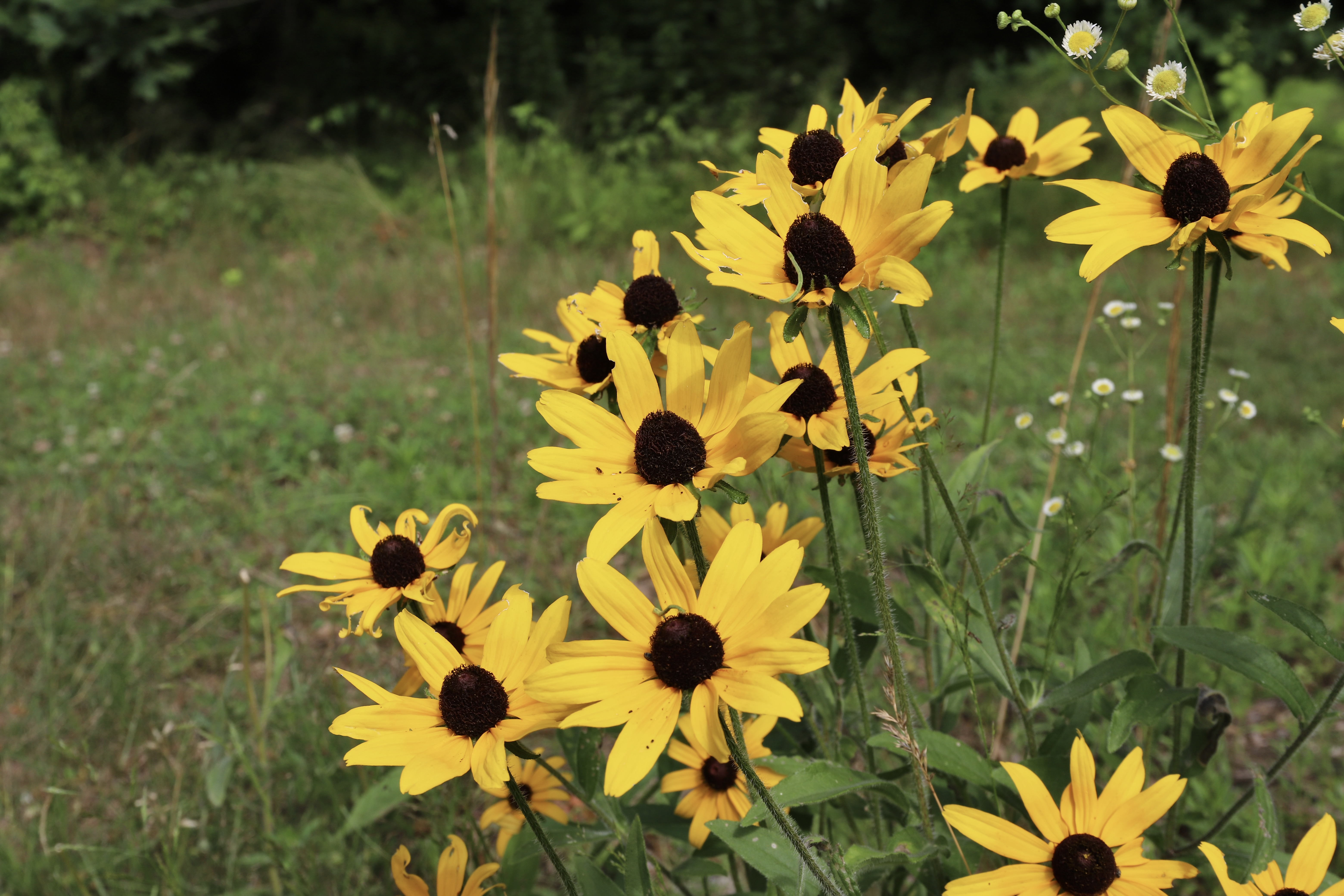
On my way to the summit of Mount Toby via the Robert Frost Trail.
Friday, July 19, 2024
Thursday, July 18, 2024
Spotted Joe-Pyeweed
Wentworth Farm Conservation Area
Amherst, Massachusetts
"Spotted joe-pyeweed thrives in marshes, rich fens and swamps. It also does well in man-made moist expanses such as ditches, seepage areas and wet fields. Above all else the plant flourishes in the non-shaded environments that are also abundant in wetlands.
It is a larval host to the Clymene moth, the eupatorium borer moth, the ruby tiger moth, and the three-lined flower moth. The plant also attracts butterflies and honeybees." -- Wikipedia
Wednesday, July 17, 2024
Pollinator Research
Wentworth Farm Conservation Area
Amherst, Massachusetts
"The Center for Agriculture, Food, and the Environment (CAFE) at the University of Massachusetts Amherst integrates research and outreach education in agriculture, food systems and the environment. The Center is the contemporary standard bearer of the university’s land-grant origins. It provides linkages from the University with vibrant business, policy and public interest sectors in the state, including agriculture, the horticultural 'green industries,' environmental decisionmakers and food system interests. The Massachusetts Agricultural Experiment Station, UMass Cranberry Station, UMass Extension and the Water Resources Research Center are all units of the Center for Agriculture, Food, and the Environment. The Center is based in the College of Natural Sciences at UMass Amherst and also works with the School of Public Health and Health Sciences, the School of Social and Behavioral Sciences and the College of Engineering." -- University of Massachusetts Amherst
Tuesday, July 16, 2024
Staghorn Sumac
Wentworth Farm Conservation Area
Amherst, Massachusetts
Staghorn Sumac "flowers in June to July depending on the part of the country in which it is found. Bees, wasps, and beetles are strongly attracted to the flowers. Some bird and small mammal species eat the fruits. The fruits are sometimes soaked in water to make a tart, somewhat lemony drink. It is occasionally cultivated for its bright red to maroon fall color and persistent red fruits. Numerous lacey leaf cultivars exist. Without attention, it can become weedy." -- U. S. Department of Agriculture
Monday, July 15, 2024
Queen Anne's Lace
I grew up calling this plant Queen Anne's Lace, even though I recognized somewhere in the back of my mind that others called it Wild Carrot. In any case, I've always been attracted to its "lacy" appearance, which I just learned has its origin in a story about Queen of England: "Anne, Queen of Great Britain is the Queen Anne for whom the plant is named. It is so called because the inflorescence resembles lace, prominent in fine clothing of the day; the red flower in the center is said to represent a droplet of blood where Queen Anne pricked herself with a needle when she was making the lace." -- Wikepedia
The idea that Anne pricked herself with a needle making the lace strikes me as pure fiction. Still, it's a great story and only serves to further convince me to keep on calling this plant Queen Anne's Lace. :-)
Sunday, July 14, 2024
Saturday, July 13, 2024
Subscribe to:
Posts (Atom)